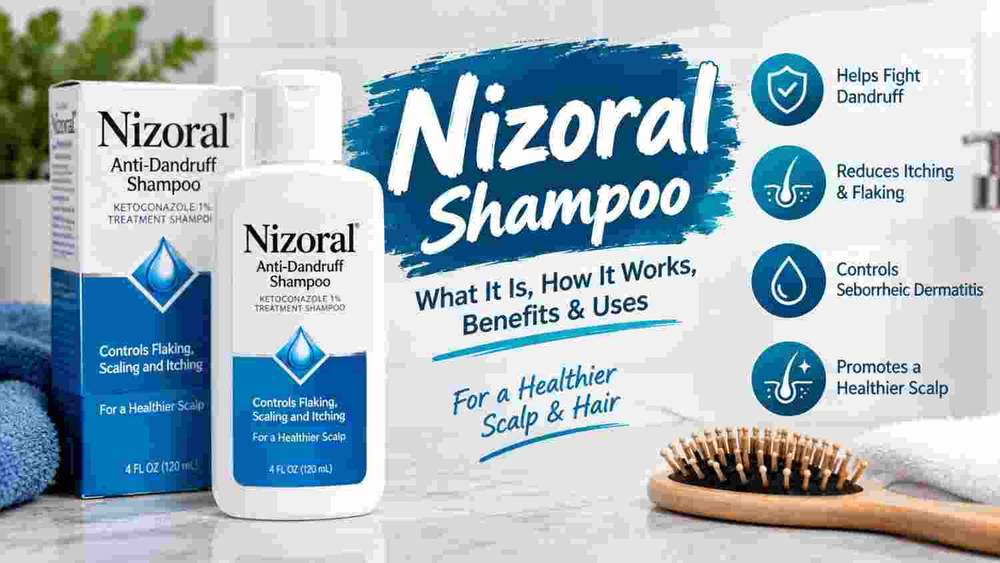
Nizoral Shampoo: The $15 Pharmacy Bottle Celebrities and Their Stylists Swear By
Picture a red-and-white bottle wedged between $90 scalp serums and $60 dry shampoos inside a celebrity stylist’s travel kit. Now picture that bottle costing less than a movie ticket — and outperforming everything around it. That’s Nizoral shampoo, the unassuming anti-dandruff wash that quietly became one of the most talked-about hair products in Hollywood.
So why is everyone suddenly talking about a medicated shampoo your dad used in the ’90s? Blame a perfect storm: Kim Kardashian’s longtime hairstylist Chris Appleton has publicly recommended it, TikTok’s #hairtok community turned it into a viral “hair growth” phenomenon, and dermatologists keep confirming its star ingredient genuinely works. Combine all three, and you’ve got the rare beauty product that’s cheap, effective, and famous all at once.
Quick Facts at a Glance
| Category | Details |
| Parent Company | Kenvue, Inc. (spun off from Johnson & Johnson in 2023) |
| Instagram Presence | #Nizoral posts number in the tens of thousands — mostly dramatic before-and-after scalps |
| TikTok | #Nizoral and #nizoralshampoo videos have pulled millions of views; parent hashtag #hairtok runs in the billions |
| X (Twitter) | A recurring guest in viral “products that actually work” threads |
| Career Peak | One of the top-selling medicated anti-dandruff shampoos in US drugstores, per industry trackers |
| Estimated Brand Value | A multimillion-dollar annual sales line inside Kenvue, a multibillion-dollar company |
| Key Popularity Driver | Chris Appleton’s stylist endorsement + viral hair-growth claims |
| Signature Price | Roughly 15–17 for a 7 oz bottle |
Nizoral Shampoo: Brand Biography & Profile
| Detail | Info |
| Full Name | Nizoral (sold over the counter in the US as Nizoral A-D) |
| Born | Ketoconazole synthesized in the late 1970s; oral version FDA-approved in 1981; shampoo followed shortly after |
| Birthplace | Janssen Pharmaceutica research labs, Beerse, Belgium |
| Creators | The research team of legendary pharmacologist Dr. Paul Janssen |
| Current Guardian | Kenvue, Inc. — the company also behind Neutrogena, Aveeno, and Listerine |
| Active Ingredient | Ketoconazole 1% (over the counter) or 2% (prescription) |
| Job Description | Kicks dandruff and seborrheic dermatitis to the curb |
| Claim to Fame | The medicated shampoo that celebrity stylists and TikTok made famous |
| Serving Instructions | Twice a week, with a 3–5 minute soak on the scalp |
The Life Story of Nizoral Shampoo: From a Belgian Lab to Bathroom-Cabinet Royalty
The Science That Started It All (1970s–1981)
Every cult product has an origin story, and this one starts in a laboratory in Beerse, Belgium. In the late 1970s, researchers at Janssen Pharmaceutica — the company founded by the famously prolific Dr. Paul Janssen — developed a powerful new antifungal compound called ketoconazole.
The oral version hit the US market in 1981 under the brand name Nizoral, treating serious fungal infections from the inside out. But doctors quickly noticed something interesting. The same fungus-killing power worked wonders when applied directly to the scalp.
The Shampoo Era and the Pharmacy Takeover
The shampoo formulation arrived soon after, and it found a hungry audience. Dandruff affects roughly half of all adults at some point, and most anti-dandruff options at the time were gentle-but-weak.
Ketoconazole hit different. It attacked Malassezia — the yeast living on everyone’s scalp that triggers flaking and itching — at the root cause instead of just masking symptoms. The 2% prescription version treated stubborn seborrheic dermatitis, while the 1% version landed on open shelves as Nizoral A-D.
For decades, it was a reliable pharmacy workhorse. Effective, respected, and honestly, a little boring.
The Celebrity Stamp of Approval
Then the beauty world discovered it. Chris Appleton — the stylist behind Kim Kardashian’s most iconic hair moments, Jennifer Lopez’s red-carpet manes, and Dua Lipa’s glossy transformations — has named Nizoral shampoo among his go-to products in interviews over the years.
The logic is simple. When you’re doing a high-profile updo or a slick-back, any flaking ruins the look. Stylists started keeping it in their kits as insurance, and word traveled from set chairs to group chats to beauty editors.
The TikTok Explosion
Following Appleton’s endorsement, #hairtok became popular.. Creators began posting 60-day scalp transformations crediting the bottle for thicker, fuller hair, and the “Nizoral for hair growth” theory went fully mainstream.
Whether that growth claim holds up is a debate we’ll settle below. Either way, the virality cemented this old pharmacy staple as a modern beauty icon.
Why Nizoral Shampoo Is Everywhere in 2026
Three forces keep this product trending right now. First, celebrity stylists still name-check it because it solves a real, unglamorous problem — flakes under hot lights.
Second, the hair-growth conversation keeps getting louder. Millions of people dealing with thinning want affordable options, and a $16 bottle feels a lot safer than a $60 monthly prescription. Third, scalp care finally became “skin care.” Consumers now understand that a healthy scalp grows healthier hair, which puts antifungal shampoos directly in the wellness spotlight.
What’s Actually Inside the Bottle?
The hero ingredient is ketoconazole, an antifungal that disrupts the cell membranes of Malassezia yeast. Less yeast means less irritation, less flaking, and less of the itching that makes you scratch your scalp raw.
Here’s where it gets interesting for the hair-growth crowd. Some research suggests ketoconazole may also lower DHT locally in the scalp — the hormone linked to pattern hair loss — and reduce inflammation that can worsen shedding.
That’s why you’ll see so many claims online. The antifungal part is proven. The regrowth part is promising but not proven. Do not lose sight of that distinction.
Your Weekly Routine, Timed and Priced
| Step | What You Do | Time | Cost |
| 1 | Soak hair with warm water | 30 sec | Free |
| 2 | Apply a coin-sized amount | 10 sec | ~$0.50 per wash |
| 3 | Massage into scalp | 1 min | — |
| 4 | Let it sit and work | 3–5 min | — |
| 5 | Rinse thoroughly | 45 sec | — |
| 6 | Condition mid-lengths and ends | 1–2 min | Optional |
| 7 | Repeat twice weekly max | — | ~$1 per wash |
Pro Tips From the Pros
Patch-test behind your ear first if you have sensitive skin. Never use it as a daily shampoo — overuse strips natural oils and can backfire. And if you’re using it before a big styling appointment, do it the night before so your scalp is calm and flake-free on the day.
Nizoral Shampoo vs. the Competition: Full Comparison
| Product | Active Ingredient | Approx. Price | Best For | How Often | The Catch |
| Nizoral A-D | Ketoconazole 1% | ~$16 (7 oz) | Stubborn, itchy dandruff | 2x per week | Can dry hair; needs conditioning |
| Generic Ketoconazole 1% | Ketoconazole 1% | ~7–10 | Same job, smaller budget | 2x per week | Basic formula, less pleasant scent |
| Head & Shoulders | Zinc pyrithione (classic formulas) | ~$7 | Mild, everyday flakes | Daily | Gentler, but weaker for tough cases |
| Selsun Blue | Selenium sulfide 1% | ~$8 | Oily, flaky scalps | 2x per week | Strong medicinal smell |
| Neutrogena T/Gel | Coal tar 0.5% | ~$14 | Thick scale, psoriasis-prone scalps | 2–3x per week | Tar scent some people hate |
The Best Affordable Dupe
Store-brand ketoconazole 1% shampoo — sold at major pharmacies for nearly half the price — contains the identical active ingredient at the identical strength. The cleansing base and fragrance differ slightly, but the fungus-fighting engine is the same. If budget matters more than the famous red bottle, the generic is a genuinely smart buy.
If you want the cult experience, though, the original is what stylists keep reaching for, and a single bottle stretches across three months of twice-weekly use.
What Dermatologists, Stylists, and Fans Really Think
The Medical Consensus
Dermatologists broadly agree on one thing: ketoconazole is one of the most effective antifungal ingredients available for dandruff and seborrheic dermatitis. The American Academy of Dermatology lists it among the top ingredients to look for in a medicated shampoo.
The hair-growth story is more cautious. A small Belgian study published in 1998 found 2% ketoconazole produced hair density improvements comparable to 2% minoxidil over six months in men with pattern thinning. Dermatologists love that data but consistently warn it’s a limited study — not a green light to skip proven treatments.
The fairest reading? By calming scalp inflammation, Nizoral shampoo may create better conditions for hair to grow. It’s a foundation, not a magic fix.
The Fan Response
Scroll through TikTok reviews and you’ll see two camps. Believers post side-by-side scalp photos showing cleared flaking in two to three weeks — and those results are almost universally real.
The hair-growth testimonials are messier. Some creators swear their edges filled in; others noticed nothing beyond a calm, clean scalp. The honest majority verdict: it absolutely fixes dandruff, and it might support growth as a bonus.
Stylist reviews lean almost entirely positive. When your reputation depends on scalps looking flawless under 4K cameras, reliability wins.
The Business Side: Nizoral Shampoo’s Brand Value and Sales Story
Let’s talk money, because this little bottle punches way above its weight. Nizoral sits inside Kenvue, the consumer health giant spun off from Johnson & Johnson in 2023 — a company whose portfolio includes Neutrogena, Aveeno, Tylenol, and Listerine.
Industry trackers consistently place Nizoral among the best-selling medicated dandruff shampoos in the US, with annual sales estimated in the multimillions. Its pricing power is remarkable: while competitors fight discount wars in the $7 range, Nizoral holds a $16 price tag and barely blinks.
Why? Scarcity of alternatives. It’s the strongest antifungal ingredient you can buy without a prescription, and nobody else owns that position in consumers’ minds. Viral fame only widened the moat — every TikTok trend wave converts curiosity into repeat purchases without the brand spending a dime on influencer contracts.
Not bad for a product that launched as a serious medical treatment four decades ago.
Frequently Asked Questions
Does Nizoral shampoo really help with hair growth?
The honest answer is “possibly, but don’t expect miracles.” Ketoconazole reduces scalp inflammation, and one small 1998 study found 2% ketoconazole performed comparably to 2% minoxidil for hair density — but it isn’t FDA-approved for hair loss, so treat any regrowth as a bonus rather than a guarantee.
How often should you use Nizoral shampoo?
The label says twice a week, and dermatologists generally agree that’s plenty. Rotate in your regular shampoo on other days, and always condition your ends because ketoconazole can dry out hair strands.
Is Nizoral safe for color-treated hair?
Yes, most color-treated users can use it, since ketoconazole isn’t a harsh color-stripper the way some medicated shampoos are. Keep the product concentrated on your scalp, rinse thoroughly, and deep-condition regularly to protect your color investment.
What’s the difference between Nizoral A-D and prescription Nizoral ?
Nizoral A-D contains 1% ketoconazole and sits on US drugstore shelves without a prescription. The 2% version is stronger, treats seborrheic dermatitis more aggressively, and requires a doctor’s prescription in the United States.
The Final Verdict on the Internet’s Favorite Medicated Shampoo
Few beauty products earn their hype. This one does. Nizoral shampoo is a genuinely effective, dermatologist-backed treatment for dandruff and itchy scalps — now wrapped in celebrity stylist credibility and viral momentum that shows no signs of slowing.
At roughly $16 for a bottle that lasts three months, it’s arguably the best value in the entire hair-care aisle. The hair-growth claims deserve skepticism, but the scalp-health payoff is real, documented, and repeatable.