Psoriasis vs Eczema: Complete Guide to Symptoms, Causes & Treatment
What Is Psoriasis? Definition and Meaning
Psoriasis is a chronic autoimmune condition that significantly speeds up the life cycle of skin cells. This rapid overproduction causes a buildup of thick, scaly patches known as plaques on the skin’s surface. It is a systemic inflammatory disorder, meaning the inflammation triggered by the immune system can affect the entire body, not just the skin.
The Immune System and Psoriasis
In psoriasis, the immune system mistakenly attacks healthy skin cells. This faulty immune response causes the body to produce new skin cells in a matter of days rather than the usual month-long cycle. This rapid turnover leads to the accumulation of cells that are not shed quickly enough, forming the characteristic plaques.
Common Triggers of Psoriasis
While the underlying cause is immune-related, certain triggers can cause psoriasis to flare up. Common triggers include:
- Stress: High stress levels can worsen the immune response and trigger outbreaks.
- Infections: Particularly strep throat, which is strongly linked to a type of psoriasis called guttate psoriasis.
- Skin Injuries: Any cut, scrape, or sunburn can induce new plaques to form at the injury site, a phenomenon known as the Koebner response.
- Certain Medications: Drugs like beta-blockers and lithium are known to trigger or worsen symptoms.
Types of Psoriasis
Psoriasis can manifest in several forms, with plaque psoriasis being the most common. Other types include:
- Guttate Psoriasis: Characterized by small, drop-shaped spots, often triggered by an infection.
- Inverse Psoriasis: Appears in skin folds as smooth, shiny, red patches.
- Pustular Psoriasis: Causes pus-filled blisters on the hands and feet.
- Erythrodermic Psoriasis: A rare and severe form that covers large portions of the body with redness and scaling.
What Is Eczema? Definition and Meaning
Eczema, or atopic dermatitis, is a condition caused by a weakened or defective skin barrier. This is a genetic and environmental condition where the skin cannot effectively retain moisture or protect itself from irritants, allergens, and bacteria. Because the barrier is compromised, the skin becomes dry, sensitive, and highly prone to infection.
The Skin Barrier and Eczema
The outermost layer of the skin acts like a brick wall, with skin cells as the bricks and lipids as the mortar. In people with eczema, this wall is “broken.” Many have a genetic mutation affecting filaggrin, a protein essential for maintaining this skin barrier. This defect allows moisture to escape and irritants to enter, causing inflammation and intense itching.
Common Triggers of Eczema
Eczema flare-ups are often triggered by external factors that irritate the already vulnerable skin, including:
- Environmental Allergens: Pollen, dust mites, and pet dander.
- Irritants: Harsh soaps, detergents, and synthetic fabrics like wool.
- Weather Changes: Low humidity and cold, dry air that strips moisture from the skin.
- Stress: As with psoriasis, stress can also be a significant trigger for eczema.
Types of Eczema
There are several types of eczema, but atopic dermatitis is by far the most common. Other types include:
- Contact Dermatitis: A localized rash caused by direct contact with an allergen or irritant.
- Nummular Eczema: Characterized by coin-shaped patches of irritated skin.
- Dyshidrotic Eczema: Causes small, itchy blisters on the hands and feet.
- Seborrheic Dermatitis: A common condition that causes scaly patches and redness, typically on the scalp.
Psoriasis vs Eczema: A Side-by-Side Comparison Table
To quickly understand the psoriasis vs eczema difference, this table highlights their distinct characteristics.
| Feature | Psoriasis | Eczema (Atopic Dermatitis) |
| Root Cause | Autoimmune condition; T-cells attack healthy skin cells. | Skin barrier defect; the skin cannot hold moisture or block irritants. |
| Appearance | Thick, raised, silvery-white scales with clearly defined edges. | Dry, red, brown, or grayish patches that often weep, ooze, and crust. |
| Primary Symptom | Itching, often with a burning or stinging sensation. Skin can crack and bleed. | Intense, maddening itch, often disrupting sleep. |
| Common Locations | Scalp, elbows, knees, lower back, and buttocks. Affects extensor surfaces. | Inner elbows, behind the knees, neck, hands, and face. Affects flexural areas. |
| Age of Onset | Usually develops between ages 15 and 35. Can occur at any age. | Often begins in early childhood and can improve with age. |
| Associated Risks | Psoriatic arthritis, cardiovascular disease, and depression. | The “Atopic March”: asthma, food allergies, and hay fever. |
How to Tell the Difference: Key Symptoms
Distinguishing between a psoriasis vs eczema rash is vital for choosing effective treatments. While both can be itchy and red, they look and feel different.
Appearance of Psoriasis
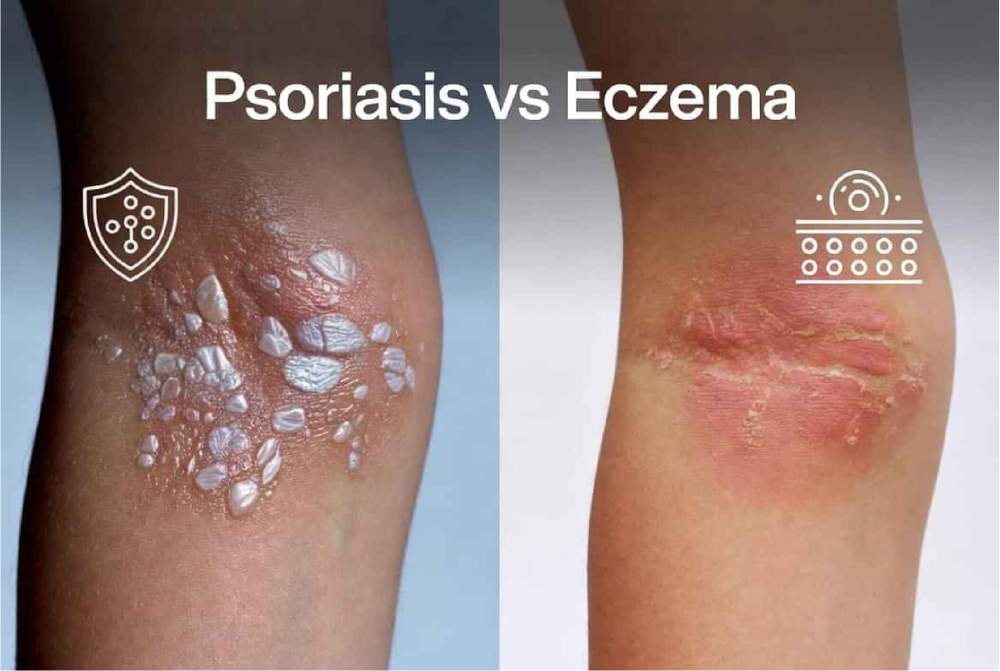
Psoriasis manifests as thick, raised patches covered in silvery-white scales. The borders of a psoriasis plaque are sharp and well-defined, making it easy to see where the plaque ends and healthy skin begins. In people with darker skin tones, these plaques may appear more purple, gray, or dark brown.
Appearance of Eczema
Eczema presents as dry, red, and inflamed patches that are less defined and more diffuse. During an acute flare-up, the skin may look weepy, crusted, and bumpy. Over time, chronic scratching can lead to leathery, thickened skin, a sign called lichenification.
Itch Level and Sensation
Both conditions cause discomfort, but the nature of the itch is different:
- Psoriasis: Itching can be mild to moderate and is often described as a burning or stinging sensation. Cracks in the skin can be quite painful.
- Eczema: The hallmark of eczema is an intense, overwhelming itch. This is often severe enough to interfere with daily activities and sleep. The “itch-scratch cycle” is a central feature, where scratching damages the skin, leading to further inflammation and a stronger itch.
Causes and Triggers of Psoriasis and Eczema
Understanding the different root causes is the most effective way to grasp the psoriasis vs eczema distinction.
Root Causes of Psoriasis
Psoriasis is fundamentally an issue with the immune system. In medical terms, it is a Th1/Th17 driven immune response where the body’s defense system is overactive and triggers inflammation that accelerates skin cell production.
Root Causes of Eczema
Eczema is primarily a problem with the skin’s structure. It is a Th2-driven immune response where an inherited deficiency in the skin’s barrier allows moisture to escape and irritants to enter. The inflammation is a reaction to these intruders, not an inherent autoimmune attack.
Diagnosis: How a Dermatologist Differentiates
Accurate diagnosis is a crucial step. Dermatologists are trained to spot the distinct characteristics of psoriasis and eczema.
Physical Exam and Medical History
The first step is a thorough physical examination and a review of your medical history. A doctor will assess:
- The location of the rash (e.g., elbows vs. inner elbows).
- The appearance and borders of the skin lesions.
- A family history of allergies, asthma, or autoimmune diseases.
When Is a Skin Biopsy Needed?
In rare cases where the visual diagnosis is unclear, a dermatologist may perform a skin biopsy. A small sample of skin is taken and examined under a microscope. This can reveal whether the inflammation is consistent with psoriasis (thickened epidermis) or eczema (spongiosis, or fluid between cells).
Treatment Options
While there is no cure for either condition, effective treatments can manage symptoms and improve the quality of life. The approach for managing psoriasis vs eczema differs due to their distinct causes.
Psoriasis Treatments
Psoriasis treatment focuses on slowing down the rapid growth of skin cells and reducing inflammation.
- Topical Therapies: Corticosteroids, vitamin D analogs, and salicylic acid creams are often first-line treatments.
- Phototherapy: Controlled exposure to ultraviolet (UV) light can significantly slow skin cell turnover.
- Biologics: These injectable medications target specific parts of the immune system to block the inflammatory pathways that cause psoriasis.
- Systemic Medications: Oral drugs like methotrexate and cyclosporine may be prescribed for severe cases.
Eczema Treatments
Eczema management prioritizes repairing the skin barrier and soothing inflammation.
- Moisturizers: Daily and generous use of rich, fragrance-free moisturizers is the cornerstone of eczema care to trap moisture in the skin.
- Topical Corticosteroids: These are used to reduce inflammation and manage flare-ups.
- Topical Immunomodulators: Non-steroidal creams like tacrolimus or pimecrolimus help control inflammation without the side effects of steroids.
- Antihistamines: These may be used to help control severe itching, particularly at night.
- Avoiding Triggers: Identifying and avoiding personal allergens and irritants is essential.
Living with the Condition: Daily Management and Lifestyle Tips
Beyond prescription medicines, daily habits are key to managing symptoms and preventing flare-ups.
- Daily Skincare Routine: Gentle cleansing with lukewarm water and immediate application of a thick moisturizer helps lock in hydration.
- Stress Management: Since stress is a common trigger for both psoriasis vs eczema, incorporate relaxation techniques like meditation, yoga, or deep breathing.
- Avoid Irritants: Use mild, fragrance-free soaps and laundry detergents to minimize skin irritation.
- Diet and Exercise: Maintaining a healthy diet and regular exercise can reduce overall inflammation and support better immune function.
Frequently Asked Questions (FAQs)
1. What is the main difference between psoriasis and eczema?
The main difference lies in the root cause and appearance. Psoriasis is an autoimmune condition that creates thick, well-defined, silvery scales. Eczema is a skin barrier defect resulting in poorly defined, dry, itchy, and sometimes weeping patches.
2. Can you have both psoriasis and eczema at the same time?
Yes, it is possible to have both conditions concurrently, although it is not common. If you suspect you have both, it is essential to see a dermatologist for an accurate diagnosis and a tailored treatment plan.
3. How do you know which treatment is right for your skin?
The right treatment depends on the specific condition. While some therapies like moisturizers and corticosteroids are used for both, biologics for psoriasis and barrier-repair creams for eczema are condition-specific. Your dermatologist will recommend the best approach based on your diagnosis.
4. Can children develop psoriasis or eczema?
Yes. Eczema is very common in children, often appearing on the face and scalp in infancy. Psoriasis can also develop in childhood, though it typically appears later, between ages 15 and 35.
5. Are psoriasis and eczema contagious?
Absolutely not. Neither condition is contagious. You cannot catch psoriasis or eczema through physical contact. They are caused by a combination of genetic and immune factors.
6. Why is it important to get the right diagnosis?
Getting an accurate diagnosis is vital because the treatments for psoriasis vs eczema can be very different. Using a psoriasis treatment for eczema, or vice versa, could be ineffective or even worsen the condition.
Conclusion: Taking the Next Step for Your Skin
Navigating the difference between a psoriasis vs eczema diagnosis is the key to unlocking proper and effective care. While they share some symptoms, they are two distinct conditions. One requires managing an overactive immune system, while the other requires repairing a broken skin barrier. Armed with this knowledge, you can partner with a dermatologist to develop a personalized strategy that works for your unique skin needs.
Don’t let persistent rashes disrupt your life. Schedule an appointment with a board-certified dermatologist today to get a definitive diagnosis and start a treatment plan that puts you back in control.
Psoriasis is a chronic autoimmune condition that significantly speeds up the life cycle of skin cells. This rapid overproduction causes a buildup of thick, scaly patches known as plaques on the skin’s surface. It is a systemic inflammatory disorder, meaning the inflammation triggered by the immune system can affect the entire body, not just the skin.
The Immune System and Psoriasis
In psoriasis, the immune system mistakenly attacks healthy skin cells. This faulty immune response causes the body to produce new skin cells in a matter of days rather than the usual month-long cycle. This rapid turnover leads to the accumulation of cells that are not shed quickly enough, forming the characteristic plaques.
Common Triggers of Psoriasis
While the underlying cause is immune-related, certain triggers can cause psoriasis to flare up. Common triggers include:
- Stress: High stress levels can worsen the immune response and trigger outbreaks.
- Infections: Particularly strep throat, which is strongly linked to a type of psoriasis called guttate psoriasis.
- Skin Injuries: Any cut, scrape, or sunburn can induce new plaques to form at the injury site, a phenomenon known as the Koebner response.
- Certain Medications: Drugs like beta-blockers and lithium are known to trigger or worsen symptoms.
Types of Psoriasis
Psoriasis can manifest in several forms, with plaque psoriasis being the most common. Other types include:
- Guttate Psoriasis: Characterized by small, drop-shaped spots, often triggered by an infection.
- Inverse Psoriasis: Appears in skin folds as smooth, shiny, red patches.
- Pustular Psoriasis: Causes pus-filled blisters on the hands and feet.
- Erythrodermic Psoriasis: A rare and severe form that covers large portions of the body with redness and scaling.
What Is Eczema? Definition and Meaning
Eczema, or atopic dermatitis, is a condition caused by a weakened or defective skin barrier. This is a genetic and environmental condition where the skin cannot effectively retain moisture or protect itself from irritants, allergens, and bacteria. Because the barrier is compromised, the skin becomes dry, sensitive, and highly prone to infection.
The Skin Barrier and Eczema
The outermost layer of the skin acts like a brick wall, with skin cells as the bricks and lipids as the mortar. In people with eczema, this wall is “broken.” Many have a genetic mutation affecting filaggrin, a protein essential for maintaining this skin barrier. This defect allows moisture to escape and irritants to enter, causing inflammation and intense itching.
Common Triggers of Eczema
Eczema flare-ups are often triggered by external factors that irritate the already vulnerable skin, including:
- Environmental Allergens: Pollen, dust mites, and pet dander.
- Irritants: Harsh soaps, detergents, and synthetic fabrics like wool.
- Weather Changes: Low humidity and cold, dry air that strips moisture from the skin.
- Stress: As with psoriasis, stress can also be a significant trigger for eczema.
Types of Eczema
There are several types of eczema, but atopic dermatitis is by far the most common. Other types include:
- Contact Dermatitis: A localized rash caused by direct contact with an allergen or irritant.
- Nummular Eczema: Characterized by coin-shaped patches of irritated skin.
- Dyshidrotic Eczema: Causes small, itchy blisters on the hands and feet.
- Seborrheic Dermatitis: A common condition that causes scaly patches and redness, typically on the scalp.
Psoriasis vs Eczema: A Side-by-Side Comparison Table
To quickly understand the psoriasis vs eczema difference, this table highlights their distinct characteristics.
| Feature | Psoriasis | Eczema (Atopic Dermatitis) |
| Root Cause | Autoimmune condition; T-cells attack healthy skin cells. | Skin barrier defect; the skin cannot hold moisture or block irritants. |
| Appearance | Thick, raised, silvery-white scales with clearly defined edges. | Dry, red, brown, or grayish patches that often weep, ooze, and crust. |
| Primary Symptom | Itching, often with a burning or stinging sensation. Skin can crack and bleed. | Intense, maddening itch, often disrupting sleep. |
| Common Locations | Scalp, elbows, knees, lower back, and buttocks. Affects extensor surfaces. | Inner elbows, behind the knees, neck, hands, and face. Affects flexural areas. |
| Age of Onset | Usually develops between ages 15 and 35. Can occur at any age. | Often begins in early childhood and can improve with age. |
| Associated Risks | Psoriatic arthritis, cardiovascular disease, and depression. | The “Atopic March”: asthma, food allergies, and hay fever. |
How to Tell the Difference: Key Symptoms
Distinguishing between a psoriasis vs eczema rash is vital for choosing effective treatments. While both can be itchy and red, they look and feel different.
Appearance of Psoriasis
Psoriasis manifests as thick, raised patches covered in silvery-white scales. The borders of a psoriasis plaque are sharp and well-defined, making it easy to see where the plaque ends and healthy skin begins. In people with darker skin tones, these plaques may appear more purple, gray, or dark brown.
Appearance of Eczema
Eczema presents as dry, red, and inflamed patches that are less defined and more diffuse. During an acute flare-up, the skin may look weepy, crusted, and bumpy. Over time, chronic scratching can lead to leathery, thickened skin, a sign called lichenification.
Itch Level and Sensation
Both conditions cause discomfort, but the nature of the itch is different:
- Psoriasis: Itching can be mild to moderate and is often described as a burning or stinging sensation. Cracks in the skin can be quite painful.
- Eczema: The hallmark of eczema is an intense, overwhelming itch. This is often severe enough to interfere with daily activities and sleep. The “itch-scratch cycle” is a central feature, where scratching damages the skin, leading to further inflammation and a stronger itch.
Causes and Triggers of Psoriasis and Eczema
Understanding the different root causes is the most effective way to grasp the psoriasis vs eczema distinction.
Root Causes of Psoriasis
Psoriasis is fundamentally an issue with the immune system. In medical terms, it is a Th1/Th17 driven immune response where the body’s defense system is overactive and triggers inflammation that accelerates skin cell production.
Root Causes of Eczema
Eczema is primarily a problem with the skin’s structure. It is a Th2-driven immune response where an inherited deficiency in the skin’s barrier allows moisture to escape and irritants to enter. The inflammation is a reaction to these intruders, not an inherent autoimmune attack.
Diagnosis: How a Dermatologist Differentiates
Accurate diagnosis is a crucial step. Dermatologists are trained to spot the distinct characteristics of psoriasis and eczema.
Physical Exam and Medical History
The first step is a thorough physical examination and a review of your medical history. A doctor will assess:
- The location of the rash (e.g., elbows vs. inner elbows).
- The appearance and borders of the skin lesions.
- A family history of allergies, asthma, or autoimmune diseases.
When Is a Skin Biopsy Needed?
In rare cases where the visual diagnosis is unclear, a dermatologist may perform a skin biopsy. A small sample of skin is taken and examined under a microscope. This can reveal whether the inflammation is consistent with psoriasis (thickened epidermis) or eczema (spongiosis, or fluid between cells).
Treatment Options
While there is no cure for either condition, effective treatments can manage symptoms and improve the quality of life. The approach for managing psoriasis vs eczema differs due to their distinct causes.
Psoriasis Treatments
Psoriasis treatment focuses on slowing down the rapid growth of skin cells and reducing inflammation.
- Topical Therapies: Corticosteroids, vitamin D analogs, and salicylic acid creams are often first-line treatments.
- Phototherapy: Controlled exposure to ultraviolet (UV) light can significantly slow skin cell turnover.
- Biologics: These injectable medications target specific parts of the immune system to block the inflammatory pathways that cause psoriasis.
- Systemic Medications: Oral drugs like methotrexate and cyclosporine may be prescribed for severe cases.
Eczema Treatments
Eczema management prioritizes repairing the skin barrier and soothing inflammation.
- Moisturizers: Daily and generous use of rich, fragrance-free moisturizers is the cornerstone of eczema care to trap moisture in the skin.
- Topical Corticosteroids: These are used to reduce inflammation and manage flare-ups.
- Topical Immunomodulators: Non-steroidal creams like tacrolimus or pimecrolimus help control inflammation without the side effects of steroids.
- Antihistamines: These may be used to help control severe itching, particularly at night.
- Avoiding Triggers: Identifying and avoiding personal allergens and irritants is essential.
Living with the Condition: Daily Management and Lifestyle Tips
Beyond prescription medicines, daily habits are key to managing symptoms and preventing flare-ups.
- Daily Skincare Routine: Gentle cleansing with lukewarm water and immediate application of a thick moisturizer helps lock in hydration.
- Stress Management: Since stress is a common trigger for both psoriasis vs eczema, incorporate relaxation techniques like meditation, yoga, or deep breathing.
- Avoid Irritants: Use mild, fragrance-free soaps and laundry detergents to minimize skin irritation.
- Diet and Exercise: Maintaining a healthy diet and regular exercise can reduce overall inflammation and support better immune function.
Frequently Asked Questions (FAQs)
1. What is the main difference between psoriasis and eczema?
The main difference lies in the root cause and appearance. Psoriasis is an autoimmune condition that creates thick, well-defined, silvery scales. Eczema is a skin barrier defect resulting in poorly defined, dry, itchy, and sometimes weeping patches.
2. Can you have both psoriasis and eczema at the same time?
Yes, it is possible to have both conditions concurrently, although it is not common. If you suspect you have both, it is essential to see a dermatologist for an accurate diagnosis and a tailored treatment plan.
3. How do you know which treatment is right for your skin?
The right treatment depends on the specific condition. While some therapies like moisturizers and corticosteroids are used for both, biologics for psoriasis and barrier-repair creams for eczema are condition-specific. Your dermatologist will recommend the best approach based on your diagnosis.
4. Can children develop psoriasis or eczema?
Yes. Eczema is very common in children, often appearing on the face and scalp in infancy. Psoriasis can also develop in childhood, though it typically appears later, between ages 15 and 35.
5. Are psoriasis and eczema contagious?
Absolutely not. Neither condition is contagious. You cannot catch psoriasis or eczema through physical contact. They are caused by a combination of genetic and immune factors.
6. Why is it important to get the right diagnosis?
Getting an accurate diagnosis is vital because the treatments for psoriasis vs eczema can be very different. Using a psoriasis treatment for eczema, or vice versa, could be ineffective or even worsen the condition.
Conclusion: Taking the Next Step for Your Skin
Navigating the difference between a psoriasis vs eczema diagnosis is the key to unlocking proper and effective care. While they share some symptoms, they are two distinct conditions. One requires managing an overactive immune system, while the other requires repairing a broken skin barrier. Armed with this knowledge, you can partner with a dermatologist to develop a personalized strategy that works for your unique skin needs.
Don’t let persistent rashes disrupt your life. Schedule an appointment with a board-certified dermatologist today to get a definitive diagnosis and start a treatment plan that puts you back in control.