Direct Earnings Attachment Meaning: A Complete Guide for UK Employees and Employers
Understanding how the government recovers benefit overpayments is crucial for both employees and employers. This guide provides a definitive explanation of the direct earnings attachment meaning, explaining the legal process that allows the Department for Work and Pensions (DWP) to collect debts directly from wages without a court order.
A direct earnings attachment can create uncertainty for employees and administrative duties for businesses. By clarifying every detail, we aim to give you total confidence in managing this process.
What is the Direct Earnings Attachment Meaning?
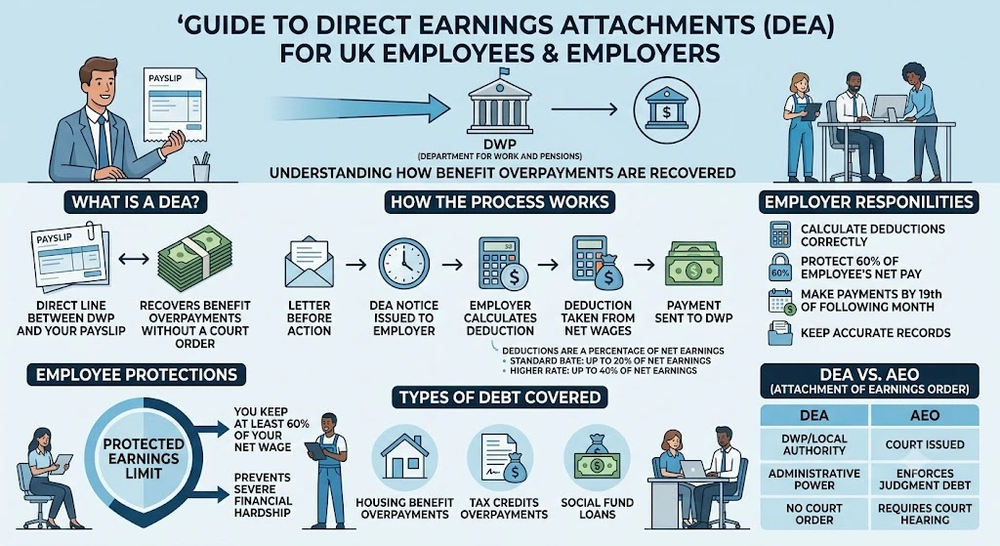
To understand the direct earnings attachment meaning, picture it as a direct line between the DWP and your payslip. It is a legal tool used to recover debts owed to the government, specifically from benefit overpayments, without requiring a court order.
If you have been overpaid benefits like Housing Benefit or Tax Credits and have not arranged a repayment plan, the DWP can instruct your employer to deduct money directly from your wages . This means the money is taken before you receive your pay, ensuring the government reclaims the funds efficiently.
The Legal Power Behind a Direct Earnings Attachment
The authority to issue a direct earnings attachment comes from the Welfare Reform Act 2012, supported by regulations introduced in April 2013 . This legislation was specifically designed to streamline the recovery of overpaid benefits.
Unlike the traditional Attachment of Earnings Order (AEO), which requires court intervention, a DEA empowers local authorities and the DWP to act swiftly. This power underscores the serious nature of the order, making it a primary method for recovering debts that would otherwise be costly to pursue through the courts.
Direct Earnings Attachment vs. Attachment of Earnings Order
It is vital to distinguish a direct earnings attachment from an Attachment of Earnings Order (AEO). While both result in wage deductions, their origins differ significantly. An AEO is issued by a court to enforce a judgment debt, such as unpaid council tax or child maintenance .
In contrast, a DEA is an administrative power used specifically for benefit overpayments and does not require a court hearing . This makes the process faster and less burdensome for the government, but it also means employees have fewer avenues to contest the deduction through the court system.
How Does the Direct Earnings Attachment Process Work?
The process begins with a notification. Before initiating a direct earnings attachment, the local authority or DWP will usually send a ‘Letter Before Action’ to the debtor, offering a chance to make voluntary repayments .
If no suitable arrangement is made, the authority will issue a formal notice to the employer. This notice legally obligates the employer to start calculating and deducting the required amount from the employee’s net pay. The employer must then pay these deductions to the authority by the 19th of the following month and continue until the debt is cleared .
What Types of Debts Trigger a Direct Earnings Attachment?
Understanding the direct earnings attachment meaning involves knowing which debts it applies to. Primarily, DEAs target overpayments of state benefits, including:
- Housing Benefit overpayments .
- Tax Credits overpayments.
- Social Fund loans .
- Other debts administered by the Department for Work and Pensions.
It is used as a last resort. First, the government would like to set up a voluntary payback arrangement. However, if you fail to respond or default on an agreement, they will proceed with a DEA to secure the repayment of public funds .
How to Calculate Direct Earnings Attachment Deductions
Deductions are a percentage of your net earnings (after tax and National Insurance), and the rates are fixed by the government. For the most common DEAs, deductions are tiered based on weekly earnings .
For example, weekly net earnings of £100.01 to £160 face a 3% deduction, while those above £520 face a 20% deduction. However, for DWP-administered DEAs, standard and higher rates apply, with a maximum deduction of 20% (or 40% in specific circumstances) and a protected earnings limit of 60% . This ensures you are always left with enough income for essential living costs.
- Standard Rate: Up to 20% of net earnings.
- Higher Rate: Up to 40% of net earnings.
Understanding Protected Earnings and Deduction Rates
A cornerstone of the direct earnings attachment meaning is the concept of “protected earnings.” This is the minimum amount of your net wage you are legally entitled to keep. For most DEAs, an employer must ensure that after the deduction is taken, your pay is not reduced below 60% of your normal net earnings . This protection prevents the order from causing severe financial hardship. Your employer is responsible for calculating the deduction while strictly adhering to this limit.
Critical Responsibilities for Employers Regarding DEAs
Employers play a pivotal role in this process. Once they receive a DEA notice, they have a legal duty to comply without delay . Failure to operate a DEA properly can result in prosecution and a fine of up to £1,000 . Their key responsibilities include:
- Calculating the correct deduction based on net earnings.
- Ensuring the employee is left with at least 60% of their net pay.
- Making payments to the issuing authority by the 19th of the following month.
- Keeping accurate records of all deductions.
- Informing the authority within 10 days if the employee leaves .
What to Do if You Receive a Direct Earnings Attachment Notice
If you are an employee receiving a notice of a direct earnings attachment, do not ignore it. The order will continue until the debt is fully paid. Contact the authority that issued the notice immediately; they may still be open to a voluntary arrangement that could stop the DEA process . If the deduction is causing genuine financial distress, discuss your protected earnings with your employer to ensure they are calculating it correctly. For employers, ensure your payroll software is correctly set up to handle the order .
Frequently Asked Questions About Direct Earnings Attachments
Q: What does “direct earnings attachment” mean in simple terms?
A: A direct earnings attachment is a government power that requires your employer to take money from your wages to repay a benefit overpayment, all without having to go to court. It is an administrative recovery method for debts like Housing Benefit overpayments .
Q: How much will be taken from my wages under a DEA?
A: The amount depends on a percentage of your net earnings. The standard deduction rate is up to 20% of your net pay, but this can rise to a 40% higher rate. Crucially, your employer must ensure that you are left with at least 60% of your normal net earnings as protected pay .
Q: Can my employer refuse to operate a Direct Earnings Attachment?
A: No, they cannot. Employers have a legal obligation to comply with a DEA notice. If they willfully refuse to make deductions, they can be taken to court and fined up to £1,000 .
Q: What is the difference between a DEA and an Attachment of Earnings Order?
A: A DEA is issued by the DWP or a local authority to recover benefit overpayments and does not require a court order. An Attachment of Earnings Order is issued by a court to recover debts like unpaid council tax or court fines .
Q: Can I stop a Direct Earnings Attachment?
A: Yes, you can stop a DEA by repaying the full debt. You can also contact the authority to arrange a voluntary repayment plan, which might lead them to cancel the DEA. Ignoring the notice will only allow the deductions to continue .
Q: What types of income are not subject to a DEA?
A: A DEA only applies to wages and salary. It does not apply to regular pension payments not linked to wages, income from a business, child maintenance payments, or student loan repayments .
Conclusion: Managing Your Direct Earnings Attachment Effectively
Understanding the direct earnings attachment meaning demystifies what can be a stressful experience. It is a legal and efficient mechanism for the government to recover public funds, but it is also structured with protections to ensure you are not left without the means to live.
If you are an employee, proactive communication with the issuing authority can often lead to a solution that avoids the order. For employers, strict adherence to the process is not just good practice but a legal requirement. By knowing your rights and responsibilities, you can navigate the process with clarity and confidence.