What Is Alternative Learning System? Meaning & Benefits
Millions of Filipinos leave school without a diploma. Poverty, distance, early pregnancy, or family duties push them out of classrooms. Without a high school credential, job offers dry up and college doors stay locked. The Alternative Learning System (ALS) changes that story. Getting clear on the alternative learning system meaning reveals a flexible, no-cost government program that hands out-of-school youth and adults a real chance at an accredited elementary or junior high school certificate—and a much brighter future.
What Does the Alternative Learning System Mean?
The alternative learning system meaning is simple: it is a free, non-formal education program run by the Philippine Department of Education (DepEd). ALS serves Filipinos who cannot enter or finish formal schooling. Instead of sitting in a regular classroom every day, learners study through self-paced modules, face-to-face sessions with mobile teachers, or digital materials. To obtain a diploma with the same weight as a formal elementary or junior high school certificate, they must pass the Accreditation and Equivalency (A&E) exam.
This definition matters because many people confuse ALS with “night school” or a second-chance diploma mill. It is neither. ALS follows an official curriculum built around life skills, functional literacy, and core academic competencies. When a learner passes the A&E exam, the government issues a certificate signed by the DepEd Secretary. That paper lets them apply for senior high school, enroll in college, or meet basic job requirements that demand a high school diploma.
Why Understanding the Alternative Learning System Meaning Matters
If you ask a returning learner what pulled them back to education, they often say, “I thought it was too late.” The real alternative learning system meaning destroys that myth. It tells a mother in a far-flung barangay that she can study after her children sleep. It tells a working teenager that weekends can become a launchpad instead of lost time.
Knowing the exact meaning also helps local governments, non-governmental organizations, and employers design better support. When a barangay captain understands that ALS graduates are legitimate DepEd completers, they can confidently allocate training funds. A company’s HR officer hires based on skill rather than school type when they are aware that an A&E diploma is equivalent to a formal junior high school certificate. Clarity around the alternative learning system meaning removes stigma and opens doors that have been closed for decades.
The Core Philosophy Behind the Alternative Learning System
The program rests on a simple belief: every Filipino has the right to learn, regardless of age, location, or life circumstances. The 1987 Philippine Constitution mandates that the state protect and promote the right to quality education at all levels. ALS is the practical expression of that promise for those the formal system leaves behind.
Three principles shape the alternative learning system meaning in daily practice:
- Learner-centeredness – Modules match the learner’s pace, learning style, and real-world responsibilities.
- Inclusivity – ALS accepts indigenous peoples, persons with disabilities, persons deprived of liberty, and working adults with zero prerequisites.
- Community grounding – Lessons often pull from local livelihood, health, and environmental issues so that learning immediately improves daily life.
This philosophy explains why ALS does not look like a regular school. It was never meant to copy the four-walled classroom. It was designed to reach where the classroom cannot go.
How the Alternative Learning System Works: Modes and Delivery
The alternative learning system meaning becomes concrete when you see how it reaches learners. ALS uses two main delivery modes.
Face-to-Face Learning
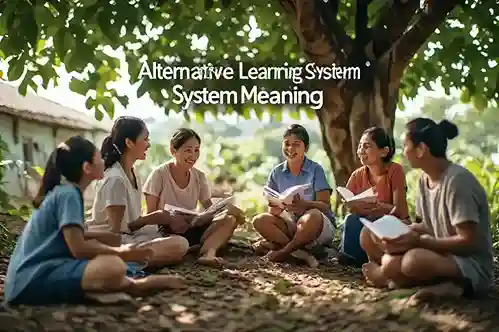
Mobile teachers and instructional managers hold sessions in barangay halls, community learning centers, church basements, or even under a tree. Schedules rotate to fit harvest seasons, market days, or shift work. A learner might attend two or three hours every Saturday instead of five days a week.
Independent Self-Study
Learners pick up printed modules or access digital materials through the DepEd Commons or ALS e-Skwela. They study at home, at a neighbor’s house, or during breaks at the factory. They only come to the learning center for assessments, portfolio reviews, and pre-test coaching.
Many implementers blend both modes. The key takeaway: ALS bends around your life, not the other way around.
Who Qualifies for the Alternative Learning System?
You qualify if you belong to any of these groups:
- Out-of-school youth aged 12 and above who have not completed elementary or junior high school.
- Adults who never finished basic education.
- Working children or teenagers who need a flexible schedule.
- Indigenous peoples living in geographically isolated communities.
- Persons with disabilities who struggle with traditional school setups.
- Persons deprived of liberty who want to rebuild their future.
- Girls and women who left school due to early pregnancy or early marriage.
There is no upper age limit. A 16-year-old farmer and a 65-year-old granny getting ready for the A&E test are both ALS learners. That broad reach is a defining part of the alternative learning system meaning.
ALS Curriculum: The Six Learning Strands Explained
The curriculum does not mimic the formal grade-level structure. Instead, it uses six learning strands that cover the same competencies. This design strengthens the alternative learning system meaning by focusing on what a learner can do, not just what they memorize.
| Learning Strand | What It Covers | Why It Matters |
| LS 1: English and Filipino Communication Skills | Reading, writing, speaking, listening in both languages. | Enables learners to fill out job applications, read contracts, and communicate clearly. |
| LS 2: Critical Thinking and Scientific Literacy | Basic science concepts, health practices, environmental awareness. | Builds the ability to question, analyze, and make evidence-based decisions. |
| LS 3 – Mathematical and Problem-Solving Skills | Arithmetic, measurement, simple algebra, financial literacy. | Prepares learners for daily budgeting, small business management, and entrance exams. |
| LS 4 – Life and Career Skills | Workplace ethics, self-management, livelihood options, digital skills. | Directly linked to employment and entrepreneurship after graduation. |
| LS 5: Comprehending Oneself and Society | Philippine history, government, rights, self-awareness, community participation. | Encourages active citizenship and personal growth. |
| LS 6 – Digital Literacy | Basic computer operation, internet safety, online research, e-learning tools. | Bridges the digital gap for learners who missed ICT classes. |
This table shows the alternative learning system meaning in action. ALS does not simply condense formal subjects. It re-arranges essential knowledge into skill buckets that make sense for adult and out-of-school learners.
ALS vs. Traditional School: A Quick Comparison
When people first encounter the alternative learning system meaning, they often ask, “How is this different from regular school?” The table below lays out the major contrasts.
| Feature | Alternative Learning System | Formal School |
| Attendance | Flexible, modular, session-based | Fixed daily schedule, regular attendance required |
| Age Requirement | No upper limit; 12+ for out-of-school youth | Age-per-grade restrictions |
| Learning Pace | Self-paced; progress based on competency | Set academic calendar; promotion by grade level |
| Credential Earned | DepEd-recognized A&E elementary or junior high school diploma | Elementary or junior high school diploma |
| Curriculum Format | Six learning strands, competency-based | Subject-based, spiral curriculum |
| Cost | Free modules, free A&E test | Often fees for miscellaneous costs, transportation |
| Progression to Senior High | Yes, upon passing A&E junior high level | Automatic after completing Grade 10 |
This side-by-side view reinforces the alternative learning system meaning as an equivalent but deliberately different path—built for those the standard model could not serve.
Accreditation and Equivalency (A&E) Exam: Converting Education into a Certification
Learning without a recognized credential changes very little. That is why the A&E test stands at the heart of the alternative learning system meaning. The exam validates that an ALS learner’s knowledge matches the competencies expected of an elementary or junior high school graduate.
The A&E test covers the six learning strands through multiple-choice questions, essays, and a portfolio assessment. The Division Testing Coordinator schedules it once a year, usually on a Sunday, so working learners can attend. Passing rates have improved steadily. According to DepEd’s 2023 data, A&E passers exceeded 60% nationwide, with some regions hitting 75% after targeted intervention.
Once a learner passes, DepEd issues a certificate or diploma. This document is valid for senior high school enrollment, college admission, TESDA skills training, and government employment requirements. Employers who check the DepEd Learner Information System can verify the certificate’s authenticity instantly.
Alternative Learning System Meaning in the Context of Lifelong Learning
ALS does not stop at basic education. The alternative learning system meaning extends into lifelong learning. A&E passers often proceed to the formal senior high school system, enroll in technical-vocational courses, or enter college. DepEd also aligns ALS with the Philippine Qualifications Framework, which means ALS credentials can stack into higher certifications.
Many community learning centers now partner with TESDA to offer bread and pastry production, welding, or computer literacy courses right after the A&E test. This seamless progression from basic literacy to livelihood skill is a deliberate feature, not an afterthought. It shows that the government sees ALS graduates as capable of contributing immediately to their families and the economy.
Real Success Stories: How ALS Opens Doors to College and Careers
Numbers and definitions only go so far. Stories give the alternative learning system meaning its heartbeat.
- Maricel, 29, single mother from Cebu – She stopped schooling at Grade 5. Through the ALS Saturday program, she earned her junior high school certificate, passed the civil service sub-professional exam, and now works as a barangay secretary.
- Jonas, 19, former out-of-school youth from Sultan Kudarat – He combined rice farming with ALS modules. After passing the A&E test, he enrolled in a state university’s agriculture program and now dreams of becoming an agricultural extension worker.
- Nanay Lita, 58, from Tondo – She learned to read and write in Filipino through ALS. She now reads prescription labels and helps her grandchildren with homework—small victories that reshaped her entire family’s daily life.
These experiences confirm that the alternative learning system meaning translates into real, measurable upward mobility.
Steps to Enroll in the Alternative Learning System
Enrollment is intentionally simple to preserve the alternative learning system meaning of easy access.
- Visit the nearest DepEd Division Office or public school that offers ALS.
- Ask for the ALS Mobile Teacher or District ALS Coordinator.
- Fill out the ALS Form 1 (Learner’s Personal Information Sheet).
- Take the Functional Literacy Test (FLT) to determine your starting level.
- Receive your learning modules and a session schedule.
- Attend orientation and start learning at your own pace.
No birth certificate? Bring a barangay certification. No ID? The mobile teacher will help you secure one. No payment? ALS is completely free. Walk in, sign up, and begin.
Common Challenges and How ALS Overcomes Them
Understanding the alternative learning system meaning also means recognizing the barriers it faces.
Limited Funding – Not every barangay has a learning center. DepEd partners with local governments and private donors to build more Community Learning Centers. The “Adopt-a-Learning-Center” program lets civic organizations sponsor facilities and materials.
Learner Dropout – Some learners stop attending due to work migration or family crises. Mobile teachers now use regular home visits, text blasts, and a buddy system to keep learners engaged.
Perception of Inferiority – Some employers still prefer “formal school” diplomas. Public advocacy campaigns and DepEd memos clarify that ALS and formal credentials are legally equivalent. The A&E certificate bears the same weight for government positions and college admission.
Digital Gap – Many learners lack gadgets. ALS e-Skwela now preloads content into tablets that learners can borrow. Community learning centers also provide computers for off-grid module access.
These solutions prove that the alternative learning system meaning is not static. It evolves to meet real-world conditions head-on.
The Future of Alternative Learning System Meaning in the Philippines
The alternative learning system meaning is expanding. DepEd’s ALS 2.0 roadmap pushes for enhanced digital integration, stronger ties with the senior high school voucher system, and the inclusion of micro-credentialing. А dedicated ALS bureau would provide the program both a long-term institutional home and a safeguarded budget line, according to a recent recommendation from the Second Congressional Commission on Education (EDCOM II).
With more than four million out-of-school youth recorded in 2023 by the Philippine Statistics Authority, the demand will not disappear. The national ALS Task Force actively trains more mobile teachers, strengthens the portfolio assessment system, and simplifies the A&E registration process. The goal is to make the alternative learning system meaning synonymous with hope and concrete opportunity for every Filipino who once thought they had run out of chances.
Frequently Asked Questions
1. What is the alternative learning system meaning in simple terms?
Through flexible learning and the A&E test, out-of-school youth and adults can obtain an elementary or junior high school certificate through DepEd’s free, non-formal education program.
2. Is the employment valid for the ALS?
Yes. The Department of Education fully acknowledges and accepts the A&E certificate.
for senior high school admission, college applications, TESDA courses, and government job requirements.
3. Who pays for the alternative learning system?
The learner pays nothing. Modules, learning sessions, and the A&E examination are all funded by the Philippine government.
4. How long does it take to finish ALS?
It depends on the learner’s pace and prior knowledge. Some finish the elementary or junior high school level within a year; others take two years or more. There is no forced deadline.
5. Can a 40-year-old enroll in the alternative learning system?
Absolutely. ALS has no age ceiling. Adult learners of any age can enroll, study, and take the A&E exam.
6. What is the difference between ALS and a regular high school?
ALS uses modular, self-paced learning with flexible schedules, while regular high school follows a fixed daily class timetable and grade-per-age progression. The diploma earned is legally equivalent.
Conclusion
The alternative learning system meaning goes far beyond a dictionary entry. It stands for free, flexible, government-backed education that sees no age limit and no dead end. It means a farmer can become an agriculturist, a teenage mother can finish her diploma, and a senior citizen can read to her grandchild. ALS hands you the tools, the timetable bends around your reality, and the credential opens real doors.
If you or someone you know needs that chance, walk into the nearest DepEd ALS center. Ask questions. Grab a module. Start. The system is built for you—now take the step.