Will Howard NFL Draft: Scouting Report & Projection
Introduction
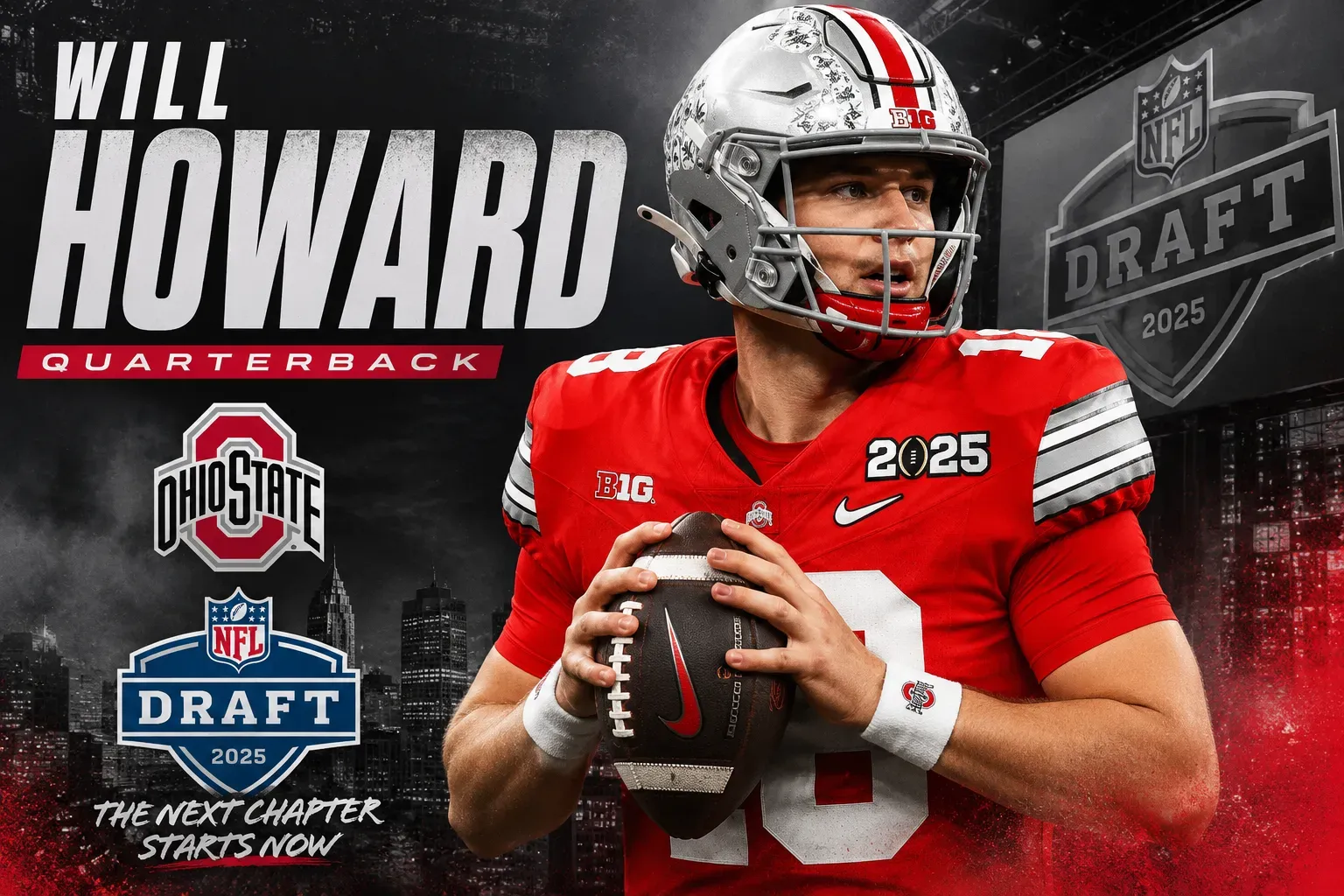
Will Howard bet on himself, leaving Kansas State for Ohio State, and the move paid off with a national championship. Now, the quarterback faces his next test: the Will Howard NFL Draft journey. You want a clear-eyed breakdown without the fluff. This guide cuts straight to his on-field processing, pinpoint accuracy, and the specific mechanical flaws that NFL coordinators will dissect. We move beyond the college stats to deliver a true evaluation of his professional future.
NFL Draft Grade and Physical Profile
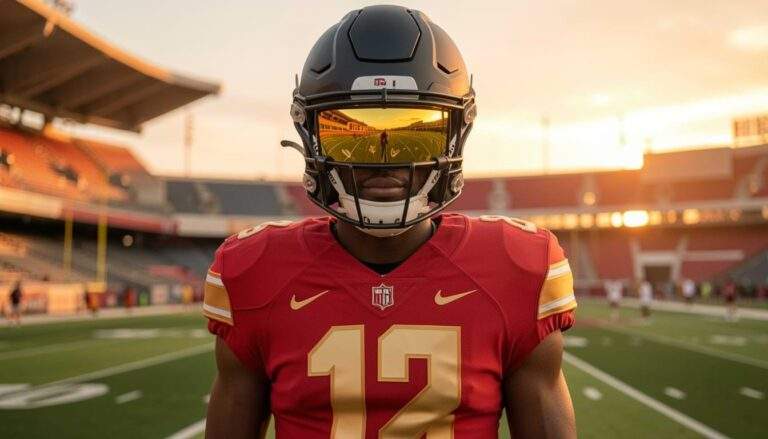
Howard presents a classic pocket-passer build that immediately catches a scout’s eye at the Senior Bowl weigh-in. His frame suggests he can withstand the physical toll of a 17-game season, a non-negotiable threshold for evaluators. Unlike shorter quarterbacks who require offenses to shift the launch point, Howard’s height allows him to see over the line cleanly. However, raw size does not automatically translate to success; it must pair with functional pocket movement. His hand size measured at 10 inches, which is significant for ball security in cold-weather stadiums.
| Attribute | Measurement | NFL Scouting Implication |
|---|---|---|
| Height | 6’4” | Ideal sightlines over offensive line; thrives in pocket-based systems. |
| Weight | 236 lbs | Possesses the density to absorb hits and maintain velocity late in games. |
| Hand Size | 10” | Aids grip stability in adverse weather, reducing fumble probability. |
| 40-Yard Dash | 4.80s (Unofficial) | Confirms a pocket operator; not a true dual-threat runner despite mobility. |
| Games Started | 45+ | One of the most experienced QBs in the class; high-volume processing history. |
Mechanical Breakdown and Functional Accuracy
Tape analysis reveals Howard operates as a rhythmic thrower who shines when his base stays disciplined. His release is compact and efficient, wasting no motion in the upper body. The core issue emerges when pressure forces him to abandon his platform; his lower-body mechanics become chaotic, leading to passes sailing high. In Chip Kelly’s offense, he mastered the art of layering throws between zone defenders, showcasing a natural feel for spacing. He consistently hits the back-shoulder fade with touch, an advanced throw that translates directly to Sunday playbooks.
- Clean Pocket Footwork: Demonstrates a firm plant step and clean weight transfer, generating tight spirals on intermediate digs and seams.
- Anticipation: Proactively releases the ball before breaks, an indicator of high football intelligence and scheme comfort.
- Chaos Mitigation: Arm strength is sufficient to drive the ball outside the numbers, but he lacks an elite “arm cannon” to bail him out of poor mechanics.
Pocket Navigation and Pressure Management
A critical metric for the Will Howard NFL Draft evaluation is his internal clock. He feels backside pressure instinctively, stepping up to evade the rush rather than bailing out backward. This trait aligns with proven NFL veterans who lack elite mobility but master subtle movements. Still, his average foot speed restricts him from being a scramble-drill creator on par with younger prospects. When forced off-script, his decision-making stays responsible; he protects the football rather than forcing reckless interceptions. The data shows a stark split between his production when kept clean versus under duress, a common but fixable challenge for transitioning passers.
Offensive Scheme Fidelity and Cognitive Load
Howard arrives with a higher cognitive baseline than most rookies after operating pro-style concepts under two different staffs. He handled full-field reads and complex pre-snap motion checks at Ohio State, a direct transfer of skill to the NFL. His experience calling protections against diverse fronts highlights his readiness to command a huddle on day one. The mental transition to a pro playbook will not overwhelm him; he has already processed similar verbage and structural concepts. This mental edge gives him a leg up on physically superior but rawer prospects competing with him on draft boards.
- Pre-Snap ID: Pinpoints Mike linebackers and communicates pressure alerts with confidence.
- Post-Snap Speed: Separates from conflict defenders quickly, progressing logically from primary to outlet options.
- Turnover Avoidance: Kept interception numbers low by understanding risk mitigation and situational football.
Statistical Deep Dive and Production Context
Numbers require context, especially when evaluating a quarterback on a talent-stacked roster. Howard’s final season produced 4,010 passing yards and 35 touchdowns, but the film shows his surrounding cast generated significant yards after the catch. His yards per attempt spiked because of vertical concepts that created wide-open windows, a luxury that shrinks in the NFL. His completion percentage hovered around 73%, yet a deeper look at his Adjusted Completion Percentage (which accounts for drops) confirms his precise ball placement. Scouts dissect his performance against top defenses like Michigan and Oregon, where his physical limitations were occasionally exposed.
- Touchdown Efficiency: High red-zone conversion rate, using his size to see openings and deliver high-point throws.
- Depth of Target: Excelled in the short-to-intermediate range; deep ball accuracy remains slightly inconsistent but functional.
- Critical Downs: Money-down converter on third-and-medium, finding soft spots against zone coverage with reliability.
Trusted Source: NFL.com Draft Tracker
Measurable Testing and Athletic Limitations
The Combine testing solidified Howard’s athletic identity, placing him firmly in the traditional pocket passer bucket. While his size-adjusted speed is not problematic, it confirms he will not be a designed run threat at the next level. Teams seeking a quarterback to execute heavy play-action bootlegs might view his stiffness as a minor hindrance. His broad jump and vertical numbers aligned with expectations, indicating functional but not explosive lower-body power. Smart offensive coordinators will design a pocket around him, understanding that his mobility exists solely for survival, not scheme.
Trusted Source: NFL Combine Results (Official)
Team Fits and Draft Capital Projection
The Will Howard NFL Draft range likely settles in the late second to third round, a sweet spot for teams seeking a high-floor backup or potential bridge starter. A franchise valuing processing speed and rhythm passing over pure physical upside will covet his profile. A club with an aging veteran starter presents an ideal learning environment, allowing him to refine his mechanical flaws in practice before stepping onto the field. Avoid systems that require constant second-reaction playmaking; his game suits structured, timing-based offenses.
- Los Angeles Rams: An ideal marriage of quarterback traits and coaching. Sean McVay’s structured offense runs on timing and precise footwork, hiding athletic deficiencies with play-design while tutoring the mental side.
- New York Jets: They need a cerebral, accurate passer to stabilize the offensive floor. Howard’s anticipation contrasts sharply with the previous project, providing a reliable option who can distribute to Garrett Wilson.
- New Orleans Saints: The cap-strapped roster needs a cheap, experienced quarterback who can operate an offense without costly mistakes. Howard fits the culture and immediate need.
Trusted Source: NFL Mock Draft Database (Consensus)
The Professional Projection Roadmap
A realistic three-year projection paints Howard as a high-end QB2 with the potential to become a solid game manager. His ceiling resembles a quarterback who wins with his brain rather than superhero athleticism, thriving when the pocket is clean and the run game is established. He will likely outperform some quarterbacks drafted ahead of him purely based on maturity and decision-making. The bust potential is low simply because his flaws—limited mobility and average arm strength—do not preclude him from efficiently running an NFL passing game if the infrastructure is solid. His floor feels safe; his ceiling depends entirely on landing in a scheme that values precision over power.
Frequently Asked Questions
What is Will Howard’s primary strength as an NFL prospect?
His advanced processing speed sits atop his scouting profile. He consistently wins pre-snap by diagnosing defensive intentions, allowing him to distribute the ball accurately to his playmakers without hesitation.
How does Will Howard’s arm strength stack up in the 2025 class?
His arm strength is functional, not elite. He can make every required NFL throw within 40 yards, but he lacks the upper-tier velocity to beat tight coverage on deep outs purely with power.
Why did Will Howard transfer from Kansas State to Ohio State?
He sought a bigger stage to showcase his skills in a pro-style passing attack. The move to Columbus allowed him to handle a higher volume of reads against better competition, elevating his draft stock significantly.
Which NFL offense fits Will Howard best?
A West Coast or Shanahan-style system fits his traits perfectly. These offenses emphasize timing, in-rhythm throws, and play-action concepts, masking the need for high-end physical tools.
Does Will Howard’s national championship win improve his draft stock?
The title validates his ability to perform under pressure on the biggest stage. While it doesn’t erase physical limitations, it confirms his intangibles and leadership for evaluators.
Is Will Howard a first-round pick in the 2025 NFL Draft?
No, consensus points away from the first round. His limited athletic ceiling pushes him to the Day 2 range, where a team will value his readiness over raw potential.
Conclusion
Stop waiting for the mainstream to catch up. You now possess the detailed film intelligence needed to see beyond the box score and understand the true arc of the Will Howard NFL Draft story. Apply this knowledge to your next mock draft or debate, and watch how sharply your arguments land. Share this breakdown with a fellow fan who still thinks physical tools define a quarterback, and set the record straight today.