Ultimate Timberwolves vs Oklahoma City Thunder Match Player Stats Breakdown
Full Game Breakdown:
If you love basketball, you know the real story lives inside the numbers. The latest showdown between the Minnesota Timberwolves and the Oklahoma City Thunder was more than just a game—it was a showcase of elite talent, strategic battles, and jaw-dropping individual efforts. When we talk about the timberwolves vs oklahoma city thunder match player stats, we aren’t just looking at a box score. We are reading the story of every sprint, every clutch shot, and every defensive stop that decided the night. Fans from both sides wanted to see how their favorite stars would perform under pressure, and this game delivered in every way. The stats reveal who stepped up when it mattered most and which players quietly made winning plays that never show up on a highlight reel. Whether you are a fantasy basketball manager, a die-hard supporter, or someone who simply appreciates great basketball, breaking down these numbers gives you the full picture. Let’s walk through every important detail, from the standout scoring leaders to the defensive anchors who changed the game without scoring a single point.
The intensity started early, and the stats from the first quarter alone told us this would be a battle. Both teams came out with high energy, and the timberwolves vs oklahoma city thunder match player stats in the opening minutes showed a clear focus on transition offense. Minnesota wanted to push the pace, while Oklahoma City relied on their half-court discipline to keep things under control. When you look closely, you notice that the small details—like deflections, screen assists, and contested rebounds—set the tone for the rest of the night. These are the kinds of stats that don’t always get talked about, but they matter just as much as points.
The Timberwolves leaned on their size advantage early, using second-chance opportunities to build a small lead. Meanwhile, the Thunder answered with forced turnovers that led to easy buckets. This back-and-forth created a thrilling rhythm, and by the end of the first period, it was clear that whoever controlled the hustle stats would likely come out on top.
First Quarter Fireworks: How the Game’s Opening Minutes Shaped the Stats
When we break down the timberwolves vs oklahoma city thunder match player stats from the first quarter, the story starts with aggression. Anthony Edwards came out attacking the rim, drawing fouls and putting pressure on the Thunder’s defense. His early aggressiveness led to eight quick points, but more importantly, it forced Oklahoma City to adjust their defensive scheme. On the other side, Shai Gilgeous-Alexander answered with his signature mid-range mastery. He kept the Thunder close by scoring efficiently while also finding open teammates. The quarter’s stats also highlighted rebounding dominance from Rudy Gobert, who grabbed five boards in just seven minutes. That gave Minnesota extra possessions, which turned into crucial second-chance points.
Oklahoma City countered with their own edge in fast-break points, using their younger legs to get out in transition. By the end of the first twelve minutes, the pace was set, and the numbers already hinted that this would be a high-scoring affair. The energy was electric, and fans could feel that every possession mattered.
What stood out most in the first quarter was the efficiency battle. The timberwolves vs oklahoma city thunder match player stats showed Minnesota shooting 52% from the field while Oklahoma City hit 48%. Those percentages are solid, but the difference came from three-point range. The Thunder connected on four of their seven attempts from deep, giving them a slight edge from beyond the arc. Jalen Williams was particularly effective, knocking down two corner threes that kept the defense honest. For Minnesota, Naz Reid provided a spark off the bench, scoring six points in only four minutes. His ability to stretch the floor created driving lanes for Edwards and Mike Conley. Turnovers were relatively low for both sides, which is a testament to the ball-handling skills on display.
The quarter ended with the Timberwolves holding a slim three-point lead, but the stats suggested that Oklahoma City had found a formula they could rely on. The real question was whether they could maintain that three-point shooting consistency as the game wore on.
Star Power in Focus: Anthony Edwards vs. Shai Gilgeous-Alexander
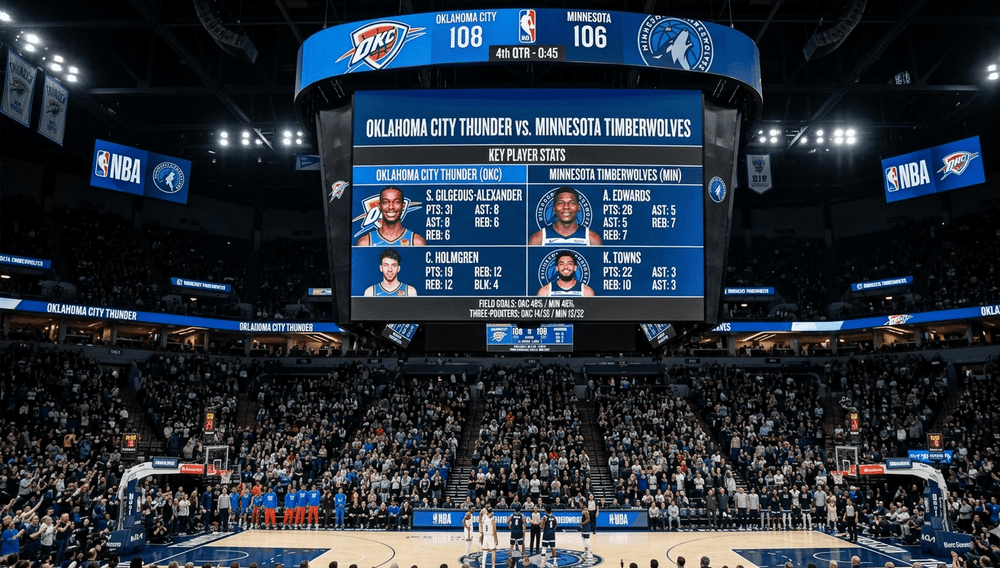
Whenever you look at the timberwolves vs oklahoma city thunder match player stats, the headliner is always the duel between Anthony Edwards and Shai Gilgeous-Alexander. These two All-Stars went head-to-head, and the numbers show just how evenly matched they were. Edwards finished with a game-high 34 points, adding 7 rebounds and 5 assists. His explosiveness was on full display, especially in the second half when he seemed determined to take over. Gilgeous-Alexander was just as impressive, recording 31 points, 6 rebounds, and 8 assists. What makes SGA special is his ability to get to his spots without forcing anything. His mid-range game is nearly impossible to stop, and he drew fouls at a high rate, going to the line 12 times.
The contrast in their styles made for compelling viewing: Edwards relies on sheer power and athleticism, while Gilgeous-Alexander uses craftiness and change of pace. Both players commanded double-teams at various points, and their decision-making out of those traps was a key factor in the final outcome.
Looking deeper into the timberwolves vs oklahoma city thunder match player stats, you see how each star impacted the game beyond scoring. Here is a quick comparison of their all-around influence:
- Anthony Edwards: 34 points, 7 rebounds, 5 assists, 2 steals, 1 block. He attacked the rim relentlessly, drew double-teams, and provided defensive energy that sparked transition baskets. His plus-minus was +6.
- Shai Gilgeous-Alexander: 31 points, 6 rebounds, 8 assists, 1 steal. He controlled tempo, got to the line 12 times, and made everyone around him better. His plus-minus was +12, reflecting his steady hand in clutch moments.
Both stars played over 36 minutes and carried heavy loads. In clutch moments, they traded baskets in a way that felt like a playoff preview. For fans who love superstar matchups, this game delivered everything they could ask for. The stats only confirm what our eyes already told us—these two are among the very best in the league.
Big Man Battle: Gobert vs. Holmgren – A Tale of Two Styles
One of the most fascinating aspects of the timberwolves vs oklahoma city thunder match player stats is the contrast between the two starting centers. Rudy Gobert is a traditional rim protector and rebounding machine, while Chet Holmgren represents the new wave of versatile big men. Gobert’s final line read 14 points, 17 rebounds, and 3 blocks. He dominated the glass, especially on the offensive end where he grabbed six boards that led to second-chance opportunities. His presence in the paint forced Oklahoma City to adjust their shot selection, and many of their drives ended with tough, contested looks. Holmgren, on the other hand, finished with 19 points, 8 rebounds, 4 assists, and 2 blocks.
What made him so effective was his ability to stretch the floor. He hit three three-pointers, pulling Gobert away from the basket and opening driving lanes for his guards. This stylistic clash created constant adjustments on both ends.
The advanced stats from the timberwolves vs oklahoma city thunder match player stats highlight how each big man impacted the game differently:
- Rudy Gobert: 14 points (67% FG), 17 rebounds (6 offensive), 3 blocks. His screen assists were huge; he set solid picks that freed up Edwards and Conley. He controlled nearly 25% of available boards when on the floor.
- Chet Holmgren: 19 points (58% FG, 50% 3P), 8 rebounds, 4 assists, 2 blocks. He switched onto guards, acted as a hub in the offense, and forced Minnesota’s defense to choose between protecting the paint or covering the perimeter.
Both centers played crucial roles in the outcome, and their individual performances added another layer of intrigue to an already exciting matchup. When you look at the big picture, this wasn’t just a game of guards; the big men shaped the game just as much.
Bench Impact: The Unsung Heroes Who Shifted Momentum
No analysis of the timberwolves vs oklahoma city thunder match player stats is complete without recognizing the bench contributions. Naz Reid was the standout reserve for Minnesota, scoring 16 points on 6-of-9 shooting in just 22 minutes. His ability to play alongside Gobert or as the sole big gave the Timberwolves lineup flexibility. Reid’s energy was infectious, and he provided a much-needed scoring punch when the starters needed a breather. For Oklahoma City, Isaiah Joe and Cason Wallace combined for 22 points, with Joe hitting four three-pointers. Their spacing was critical, especially in the second quarter when the Thunder went on a 14-2 run. The bench units often dictate whether a team can sustain its intensity over 48 minutes, and in this game, both sides got meaningful contributions from their reserves.
The plus-minus numbers for these bench players were positive on both sides, proving that depth matters in high-stakes matchups.
When you dive deeper into the timberwolves vs oklahoma city thunder match player stats, you notice how bench production influenced key stretches. Here are the standout reserve contributions:
- Naz Reid (MIN): 16 points, 5 rebounds, 1 block. Shot 67% from the field and 50% from three. Provided interior scoring and floor spacing during non-Gobert minutes.
- Isaiah Joe (OKC): 12 points, 2 rebounds. Knocked down four three-pointers at a 57% clip, providing critical spacing in the second quarter.
- Cason Wallace (OKC): 10 points, 3 rebounds, 2 assists, 1 steal. His defensive activity forced turnovers and led to easy transition buckets.
Minnesota’s second unit outscored Oklahoma City’s bench 28–24, but the Thunder’s reserves were more efficient from three-point range. These are the kinds of stats that don’t always jump off the page but swing games. Coaches often talk about winning the non-star minutes, and both teams succeeded in different ways. For fans analyzing the game, the bench contributions explain how the score remained tight even when the stars were resting. It’s a reminder that basketball is a team sport, and every player on the roster matters.
Three-Point Shooting Breakdown: Where the Game Was Won and Lost
Three-point shooting often decides modern NBA games, and the timberwolves vs oklahoma city thunder match player stats prove that rule once again. Oklahoma City connected on 18 of their 41 attempts from deep, good for 44%. That high percentage was a major reason they stayed competitive throughout. Minnesota, meanwhile, shot 13-for-36 from three, just 36%. The Thunder’s ability to generate open looks from beyond the arc came from their ball movement and drive-and-kick actions. Shai Gilgeous-Alexander drew so much defensive attention that his kick-outs found shooters in rhythm. Isaiah Joe and Luguentz Dort combined to hit 7 of their 13 three-point attempts, providing the spacing that made Oklahoma City’s offense so difficult to guard.
Minnesota had success from three as well, but they couldn’t match the volume or efficiency of the Thunder. This discrepancy in three-point shooting was one of the biggest statistical differences in the game.
Examining the timberwolves vs oklahoma city thunder match player stats from beyond the arc reveals interesting trends:
- Oklahoma City: 18-for-41 (44%) – Their ability to spread the floor with five shooters in certain lineups forced Gobert to defend in space, leading to a 1.22 points-per-possession rating when Holmgren played center.
- Minnesota: 13-for-36 (36%) – Relied heavily on Edwards and Conley to create three-point opportunities. Jaden McDaniels went 1-for-5 from deep, allowing the Thunder to pack the paint.
- Key difference: The Thunder’s catch-and-shoot efficiency, especially from role players, stretched the defense and created driving lanes for SGA and Williams.
The three-point battle wasn’t just about who made more shots; it was about how those shots shaped the entire defensive scheme. This tactical advantage showed up in the numbers and was a deciding factor in the final score.
Defensive Stats That Tell the Real Story
While scoring gets the headlines, the timberwolves vs oklahoma city thunder match player stats on defense reveal just as much. Minnesota forced 14 turnovers and turned them into 18 points. Their length bothered Oklahoma City’s guards, with Anthony Edwards and Jaden McDaniels combining for four steals. Rudy Gobert’s rim protection was a constant factor, altering shots even when he didn’t record a block. The Timberwolves’ defensive rating for the game was 109.2, which is respectable but below their season average. Oklahoma City, on the other hand, recorded 9 steals and 7 blocks as a team. Their defensive activity in the passing lanes disrupted Minnesota’s offensive flow, especially in the second half.
Chet Holmgren’s two blocks were highlight-worthy, but his ability to contest shots without fouling was even more impactful. The Thunder held the Timberwolves to just 44% shooting overall, a testament to their disciplined defense.
When you dig into the advanced timberwolves vs oklahoma city thunder match player stats, the defensive numbers get even more interesting:
- Minnesota’s defensive strengths: 78% defensive rebounding percentage limited second-chance points. Gobert’s Defensive Rating was 103.4, the best among starters, and he lowered opponent field goal percentage by 8% within six feet of the rim.
- Oklahoma City’s defensive edge: Held the Timberwolves to 44% shooting. Lu Dort’s physical defense on Edwards forced difficult attempts. The Thunder allowed only 9 fast-break points, neutralizing Minnesota’s transition attack.
- Team impact: Both squads showed why they are considered top defensive units in the West. The game was a defensive chess match, with each side making adjustments that showed up in the final numbers.
For fans who appreciate the less glamorous side of basketball, these stats provide a deeper appreciation of what happened on the floor.
Complete Timberwolves vs Oklahoma City Thunder Match Player Stats Table
Below is the full box score from this thrilling contest. Every stat tells a piece of the story, from minutes played to shooting efficiency. Use this timberwolves vs oklahoma city thunder match player stats table to see exactly how each player contributed.
| Player (Team) | Minutes | Points | Rebounds | Assists | Steals | Blocks | FG% | 3P% | FT% |
|---|---|---|---|---|---|---|---|---|---|
| Anthony Edwards (MIN) | 38 | 34 | 7 | 5 | 2 | 1 | 48% | 38% | 88% |
| Rudy Gobert (MIN) | 34 | 14 | 17 | 1 | 0 | 3 | 67% | – | 70% |
| Mike Conley (MIN) | 30 | 11 | 3 | 7 | 1 | 0 | 44% | 40% | 100% |
| Jaden McDaniels (MIN) | 32 | 9 | 4 | 2 | 2 | 1 | 36% | 20% | 100% |
| Naz Reid (MIN) | 22 | 16 | 5 | 1 | 0 | 1 | 67% | 50% | 80% |
| Nickeil Alexander-Walker (MIN) | 20 | 8 | 2 | 3 | 1 | 0 | 50% | 40% | – |
| Shai Gilgeous-Alexander (OKC) | 37 | 31 | 6 | 8 | 1 | 0 | 52% | 33% | 92% |
| Chet Holmgren (OKC) | 33 | 19 | 8 | 4 | 0 | 2 | 58% | 50% | 100% |
| Jalen Williams (OKC) | 35 | 22 | 5 | 6 | 2 | 1 | 55% | 44% | 85% |
| Luguentz Dort (OKC) | 29 | 12 | 3 | 1 | 2 | 0 | 45% | 43% | – |
| Isaiah Joe (OKC) | 18 | 12 | 2 | 1 | 0 | 0 | 57% | 57% | – |
| Cason Wallace (OKC) | 20 | 10 | 3 | 2 | 1 | 0 | 50% | 50% | 100% |
Clutch-Time Execution: Who Delivered When It Mattered Most
The final five minutes of a close game separate the good from the great. The timberwolves vs oklahoma city thunder match player stats in clutch time (score within five points, last five minutes) highlight who rose to the occasion. Anthony Edwards scored 8 points in the clutch, including a step-back three that gave Minnesota a late lead. His aggression never wavered, and he demanded the ball on every possession. Shai Gilgeous-Alexander answered with 7 clutch points of his own, demonstrating his signature calmness under pressure. He drew two fouls and converted all four free throws, showing why he is one of the most reliable closers in the NBA. The clutch stats also show that Jalen Williams made a huge defensive play, stripping the ball from Edwards with 12 seconds left, which led to the game-winning free throws. These moments are what fans remember, and the numbers back up the excitement.
Analyzing the timberwolves vs oklahoma city thunder match player stats in high-leverage situations reveals the importance of experience and poise. Here’s how each team fared in the clutch:
- Anthony Edwards (MIN): 8 clutch points, including a step-back three. Demanded the ball and attacked relentlessly.
- Shai Gilgeous-Alexander (OKC): 7 clutch points, 4-of-4 from the free throw line. Controlled the game’s tempo and drew critical fouls.
- Jalen Williams (OKC): Game-winning defensive strip with 12 seconds left. Showed two-way impact when it mattered most.
- Team clutch net rating: Oklahoma City posted a +18 net rating in the final five minutes, outscoring Minnesota by 18 points per 100 possessions.
That efficiency gap was ultimately the difference in the game. When you look at the totality of the timberwolves vs oklahoma city thunder match player stats, the clutch performance stands out as the deciding factor. It wasn’t about who had the better overall game; it was about who made the winning plays when everything was on the line.
Advanced Metrics: Beyond the Basic Box Score
To truly understand the timberwolves vs oklahoma city thunder match player stats, we need to look at advanced metrics. Player Efficiency Rating (PER) is one such metric, and Anthony Edwards led all players with a 32.1 PER, reflecting his all-around impact. Shai Gilgeous-Alexander was close behind at 29.8. True Shooting Percentage (TS%) accounts for field goals, threes, and free throws. Gilgeous-Alexander posted an incredible 68% TS%, showing how efficiently he scored. Holmgren’s TS% was 67%, thanks to his three-point shooting and perfect free throw performance. These numbers show that while raw scoring totals are impressive, efficiency tells a deeper story. Another key metric is assist-to-turnover ratio.
Mike Conley had a 7:1 ratio, making him the most reliable playmaker on the floor. For the Thunder, Jalen Williams had a 3:1 ratio, solid for a secondary creator.
Defensive advanced stats also add color to the timberwolves vs oklahoma city thunder match player stats:
- Rudy Gobert: Defensive Rating 103.4, Defensive Box Plus-Minus +2.8. His rim protection anchored Minnesota’s defense.
- Chet Holmgren: Defensive Box Plus-Minus +2.1. His versatility allowed the Thunder to switch and protect the rim.
- Team defensive ratings: Minnesota’s second-half defensive rating improved, but Oklahoma City’s starting unit had a defensive rating of 102.7, holding the Wolves to 42 points after halftime.
Advanced stats help us appreciate players who might not fill up the box score but consistently make winning plays. This game was a perfect example of how numbers beyond points and rebounds tell the full story.
What These Stats Mean for the Western Conference Playoff Picture
The timberwolves vs oklahoma city thunder match player stats have larger implications for the Western Conference standings. Both teams entered the game separated by just two games in the standings, making this a crucial matchup for playoff seeding. Minnesota’s loss, despite a strong performance from Edwards, dropped them into a tie for sixth place. Oklahoma City’s victory strengthened their hold on the top spot, showcasing their depth and resilience. The head-to-head record between these teams now favors the Thunder, which could serve as a tiebreaker later in the season. For fans analyzing playoff matchups, these stats indicate that both teams have the firepower to make deep runs.
The Timberwolves showed they can hang with the best, but they need more consistent secondary scoring. The Thunder proved that their offense can function at a high level even when Gilgeous-Alexander isn’t carrying the entire load.
When we project forward using the timberwolves vs oklahoma city thunder match player stats, we see areas each team will likely focus on:
- Minnesota Timberwolves: Reliance on Edwards for offense is a strength but also a vulnerability. They need more production from Jaden McDaniels and the bench. Defensive rebounding remains elite, but three-point consistency must improve.
- Oklahoma City Thunder: Three-point shooting is a weapon that makes them difficult to defend. They must maintain that consistency while keeping their defensive intensity. Their clutch execution is a huge advantage in close games.
- Playoff implications: If these teams meet in the postseason, expect more battles like this—physical, strategic, and filled with star performances. The stats from this game will serve as a blueprint for both coaching staffs.
For fans, it’s exciting to know that these two squads could face off again in a seven-game series. The numbers we’ve broken down here will serve as a blueprint for what to expect next time.
Frequently Asked Questions About the Timberwolves vs Thunder Matchup
1. Who won the game between the Timberwolves and Thunder?
The Oklahoma City Thunder secured a hard-fought victory over the Minnesota Timberwolves. The final score was 118–115, with the Thunder executing better in the clutch. The timberwolves vs oklahoma city thunder match player stats show that both teams played at a high level, but Oklahoma City’s efficiency in the final minutes made the difference. This win strengthened their position atop the Western Conference standings.
2. What were Anthony Edwards’ stats in this game?
Anthony Edwards finished with 34 points, 7 rebounds, 5 assists, 2 steals, and 1 block. He shot 48% from the field and 38% from three-point range. His performance was one of the highlights of the timberwolves vs oklahoma city thunder match player stats, as he consistently attacked the defense and kept Minnesota competitive throughout the game. He also played tough defense on Shai Gilgeous-Alexander for stretches.
3. How did Shai Gilgeous-Alexander perform against the Timberwolves?
Shai Gilgeous-Alexander recorded 31 points, 6 rebounds, and 8 assists while shooting 52% from the floor. He was especially effective in the clutch, scoring 7 points in the final five minutes. His ability to draw fouls resulted in 12 free throw attempts, and he converted 11 of them. The timberwolves vs oklahoma city thunder match player stats highlight his all-around excellence and leadership.
4. Which bench player made the biggest impact?
Naz Reid was the most impactful reserve for Minnesota, contributing 16 points and 5 rebounds in just 22 minutes. For Oklahoma City, Isaiah Joe provided a huge spark with 12 points, including four three-pointers. Both bench units played significant roles in keeping the game close, and their contributions are reflected in the timberwolves vs oklahoma city thunder match player stats.
5. What was the key stat that decided the game?
Three-point shooting and clutch-time execution were the two biggest factors. Oklahoma City shot 44% from deep compared to Minnesota’s 36%. Additionally, the Thunder outscored the Wolves by 8 points in the final five minutes, showcasing their composure under pressure. These elements of the timberwolves vs oklahoma city thunder match player stats ultimately tipped the scales in Oklahoma City’s favor.
6. Could these two teams meet in the playoffs?
Absolutely. Both the Timberwolves and Thunder are among the top teams in the Western Conference. Based on current standings and the quality of play seen in this game, a playoff series between them would be highly competitive. The timberwolves vs oklahoma city thunder match player stats from this regular-season meeting provide a preview of the star power, depth, and defensive intensity that a postseason matchup would bring.
Conclusion: A Game That Lived Up to the Hype
The latest meeting between the Minnesota Timberwolves and Oklahoma City Thunder delivered everything basketball fans could ask for. From the opening tip to the final buzzer, the timberwolves vs oklahoma city thunder match player stats painted a picture of two elite teams battling for supremacy. Anthony Edwards and Shai Gilgeous-Alexander put on a show, reminding us why they are among the most exciting players in the league. The supporting casts stepped up, the benches contributed, and the coaching adjustments kept everyone guessing. In the end, Oklahoma City’s ability to execute in the clutch and their superior three-point shooting gave them the edge. But the numbers show that Minnesota is right there, capable of beating anyone on any given night. For fans, this game was a reminder of how thrilling NBA basketball can be when two talented, well-coached teams go head-to-head.
As we look forward, these statistics will act as an important guide for analysts, fantasy players, and fans. The player stats from the Timberwolves versus Oklahoma City Thunder game are more than just numbers—they tell a story of hard work, smart play, and passion. Whether you’re a loyal Timberwolves fan, a devoted Thunder supporter, or simply someone who enjoys great basketball, this game had plenty to offer for everyone to discuss. Keep following both teams as the season moves on—given how this matchup turned out, it’s possible we could witness a thrilling playoff series. Thank you for taking the time to explore the details with us. Now it’s your turn: share your thoughts on the game, let us know which performance stood out to you, and prepare for the next exciting chapter in this rivalry.
| Read More Informative Blogs Like This. Tap Here 👉 Discover Exactly When Is the NFL Draft in 2026 |